
Salutations, Olio aficionados! 👋
Welcome to the 280th edition of Weekly Olio. We’re thrilled to introduce a fresh new twist to your Sundays: Publisher Parmesan, our hand-picked, thoughtfully crafted edition designed to spark inspiration and insights for the week ahead.
It’s the perfect way to unwind, recharge, and prepare for the week with something truly worth savoring.
If you’re new here and you’re looking for more long-form, crispy writing, click the link to subscribe under this GIF 👇

A word from our Sponsors…
Stop Spending. Start Scaling.

Most brands running external traffic aren't scaling — they're just spending. Levanta's free playbook breaks down 7 proven strategies: what works, what bleeds budget, and how top brands drive millions in off-Amazon revenue.
The $300 Movie That Could Disrupt Hollywood
For more than a century, filmmaking has been one of the world's most capital-intensive creative industries.
A great story alone was never enough. Aspiring directors needed expensive cameras, production crews, actors, studio backing, and, perhaps most importantly, access to people willing to finance an idea that might never make its money back. Talent certainly mattered, but so did connections, credentials, and capital.
Artificial intelligence is beginning to rewrite that equation.
Across China, a new generation of filmmakers is producing award-winning short films with teams of fewer than ten people and budgets that would barely cover lunch on a traditional movie set. Some have never attended film school. Others were working in real estate or studying unrelated subjects only months before their films attracted millions of viewers.
At first glance, this looks like another story about AI making creative work cheaper.
It is something much bigger.
Every technological revolution lowers the cost of production. But when production becomes inexpensive, value rarely disappears. It simply moves elsewhere.
The question isn't whether AI will make filmmaking easier.
It's whether it is changing who gets to become a filmmaker in the first place.

For most of modern cinema, there was a fairly predictable path to becoming a director. You studied at an elite film school, entered competitions, built relationships within the industry, and slowly worked your way up through production roles. Even then, success was far from guaranteed. Studios preferred established directors, recognizable actors, and projects that looked financially safe.
That is why the story of Liu Ziyu feels so remarkable.
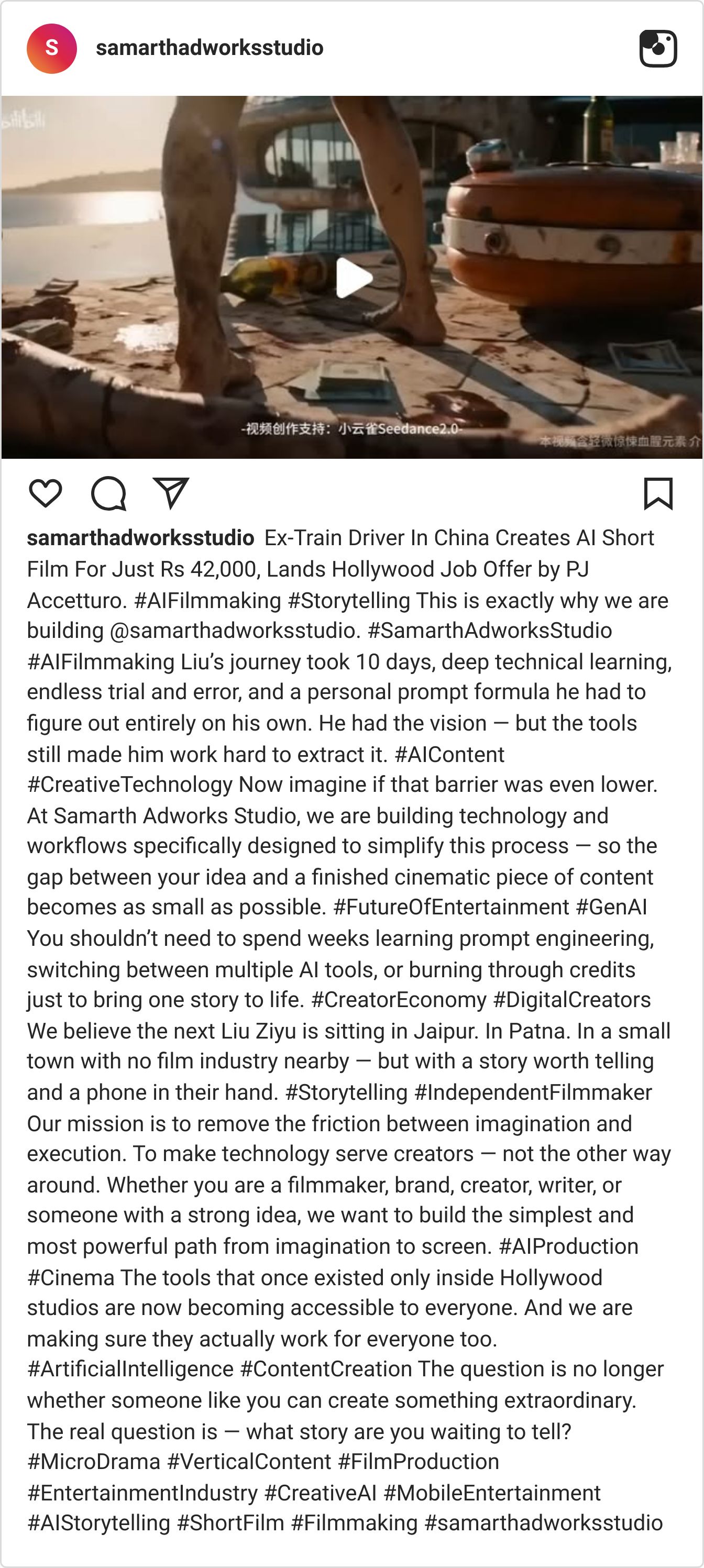
Liu wasn't a graduate of China's prestigious film academies. He worked in real estate in Yunnan province. Yet in May, his AI-assisted short film Zombie Scavenger surpassed 100 million online views, earned widespread comparisons to Love, Death & Robots, and even attracted interest from a Hollywood producer. Around the same time, another young creator, Meng Ke, won "Best AIGC Director" at the Beijing International Film Festival for a film produced with AI while working from an internet café. Neither followed the traditional path into cinema. The industry simply became accessible before they ever entered it.
These stories are unusual today. They may become increasingly common tomorrow.
Hollywood's Biggest Barrier Was Never Creativity
The romantic image of filmmaking has always centered on creativity. The business reality has been very different.
Movies are expensive because they require an extraordinary amount of coordination. Producers must secure financing, hire actors, build sets, organize large crews, manage equipment, and often spend years moving a project from script to screen. In China, directors interviewed in the source article describe projects where attracting even a single well-known actor can require an eight-figure RMB fee, consuming a significant portion of the production budget before filming even begins.
This financing model inevitably favors people who already possess reputation and industry relationships.
Artificial intelligence attacks that constraint directly.
According to iQIYI CEO Gong Yu, AI has reduced production costs by "an order of magnitude." Instead of coordinating hundreds of people, creators increasingly work in teams of five or seven, generating scenes overnight and refining them the following day. The barrier shifts from raising capital to generating ideas.
For the first time in modern filmmaking, access to capital is no longer the primary gatekeeper.
AI Didn't Replace Directors. It Changed Their Job
Perhaps the biggest misconception surrounding AI filmmaking is that machines are replacing human creativity.
The transcript suggests something far more nuanced.
Phoenix Liu, whose AI-generated feature Seven Fleeting Days won an award at the Beijing International Film Festival, describes spending weeks breaking down every scene into extraordinary detail because AI still struggles to understand emotional context, relationships between characters, and cinematic intent. A prompt isn't simply a description of what should happen. It becomes an extension of the director's vision.
The contrast becomes even clearer when comparing prompts.
A generic prompt tells the model that a character smiles, falls asleep, or embraces another person. A carefully crafted prompt specifies camera movement, emotional motivation, framing, pacing, and transitions between scenes. The technology generates images, but the director still determines why those images matter.
In other words, AI is reducing the importance of execution while increasing the importance of judgment.
That is a profound shift. Because judgment scales far less easily than technology.
The GTM Playbook Behind Warmly's Acquisition

Warmly ran pipeline, outreach, and lead scoring on autopilot for hundreds of startups — before a single sales hire.
HubSpot acquired them for it. Now the cofounders are walking you through the exact system, live, before they disappear into product. Join the Builder Session on August 12.
Leave with an agentic GTM stack you can replicate this week. Plus HubSpot Credits when you join HubSpot for Startups.
When Production Becomes Cheap, Taste Becomes Expensive
Every technological revolution changes what is scarce.
Photography made portrait painting less valuable but elevated artistic composition.
Digital publishing made printing inexpensive but increased the importance of distribution.
Streaming democratized music production while making discovery the industry's greatest challenge.
AI filmmaking appears to be following the same pattern.
One of the most striking examples in the transcript is The Tale of the Peony, an award-winning seven-minute film that reportedly cost around RMB 2,000 (roughly $300) to produce using AI tools and software subscriptions. Yet the low production cost did not eliminate human effort. The creators spent months refining visual styles, redrawing keyframes, rewriting prompts, and preserving imperfections that made scenes feel emotionally authentic.
One director even chose to keep a continuity error because the emotional performance worked so well that correcting the mistake would have weakened the scene.
That decision says something important.
When AI can generate almost anything, the competitive advantage no longer lies in generation.
It lies in knowing what deserves to remain. Taste becomes the new bottleneck.
Studios Are No Longer the Only Gatekeepers
Historically, film studios controlled nearly every stage of the creative process.
They decided which scripts received funding, which directors deserved opportunities, and which films reached audiences.
Artificial intelligence weakens that position.
A creator no longer needs millions of dollars to produce a compelling proof of concept. Viral distribution, film festivals, and online platforms increasingly allow unknown directors to demonstrate their abilities before ever entering the traditional system. Rather than discovering talent after years inside the industry, studios may begin discovering it after a single successful AI-generated film.
This represents a subtle but significant redistribution of power.
Studios are unlikely to disappear. Large-scale productions, live-action filmmaking, and global franchises will continue requiring enormous resources.
But their role may evolve.
Instead of controlling who gets to create, they may increasingly compete to identify and finance creators who have already proven themselves independently.
That is remarkably similar to what happened in publishing, music, and software, where platforms gradually became discovery engines rather than gatekeepers.
Closing Thought
Every creative industry has historically been defined by the cost of production.
Printing presses determined who became publishers.
Recording studios determined who became musicians.
Film studios determined who became directors.
Artificial intelligence is dismantling one of the largest barriers ever built in filmmaking: the cost of turning imagination into moving images.
That does not mean every AI-generated film will be great, just as inexpensive publishing did not make every book worth reading. Lowering the cost of creation increases the supply of content. It does not automatically increase its quality.
History suggests that when production becomes abundant, value shifts elsewhere.
In filmmaking, that "elsewhere" may be taste, storytelling, curation, and intellectual property.
The next great film studio may not own the largest soundstage.
It may own the strongest creator ecosystem.
And the next celebrated director may not emerge from a prestigious film academy.
They might emerge from an internet café, armed with a laptop, a compelling story, and an AI model that has made the impossible suddenly affordable.
Interested in learning more about AI? Check out our previous coverage here:
That’s all for this week. If you enjoyed this edition, we’d really appreciate if you shared it with a friend, family member or colleague.
We’ll be back in your inbox 2 PM IST next Sunday. Till then, have a productive week!
Disclaimer: The views, thoughts, and opinions expressed in the text belong solely to the author, and not necessarily to the author's employer, organization, committee or other group or individual.